Filter by topics

  • All posts155
  • AMU3
  • Advanced simulation7
  • Basics10
  • EBRAINS5
  • GSoC8
  • Model construction7
  • Special applications8
  • Stimulation3
  • Stroke3
  • TVB team1
  • Workshop2
  • award1
  • berlin1
  • brainmodes1
  • collaboration5
  • conference3
  • development14
  • epilepsy14
  • event1
  • funding9
  • google7
  • hbp11
  • hpc2
  • media2
  • open-science3
  • paper6
  • press4
  • release24
  • software27
  • spotlight1
  • support2
  • virtualbraincloud3
  • website3

Read the latest posts

  • TVB delivers core technology to French Nautilus project, part of the France 2030 initiative
  • New paper: Virtual brain twins: from basic neuroscience to clinical use
  • Congratulations to Prof. Dr. McIntosh & Prof. Dr. Ritter for their new positions as chair & deputy chair of INCF
  • Virtual Brain Twin project funded by European Commission with 10 million €, addressing psychiatric diseases
  • TVB Co-Lead Petra Ritter heading € 60 Mill funded project TEF-Health
  • New Release: TVB version 2.7.1 integrates the siibra & BCT for Python!
  • eBRAIN-Health project awarded funding by European Union!
  • TVB on EBRAINS highlighted in the last CORDIS news!
  • Learn Bayesian Data Analysis with Michael Betancourt, a core developer of Stan & expert on Hamilton Monte Carlo
  • The Virtual Brain: Facility Hub is the official EBRAINS competence center for TVB
blog.notice.struct
  • Published:July 30, 2026

    • epilepsy
    • Special applications
    • funding

    TVB delivers core technology to French Nautilus project, part of the France 2030 initiative

    • BrainXplore_Nautilus.png

      Interactive 3D visualization for a virtual brain, contributed to Nautilus by the VB Tech BrainXplore platform.

    Viktor Jirsa is leading the Nautilus project, part of the France 2030 initiative and funded with 3 million EUR. Its objective is to develop an innovative technology platform capable of generating a personalized digital twin of the human brain to simulate the effects of targeted brain stimulation before treatment.

    Digital brain twins for individual therapy

    Creating a digital brain twin is possible thanks to the groundwork of The Virtual Brain technology. These digital brain twins can then be used to:

    • Identify new pathophysiological mechanisms
    • Predict the progression of neurodegeneration
    • Refine the diagnosis and stage of neurodegenerative diseases
    • Virtually evaluate the response to certain treatments, such as localized electrical stimulation

    Digital brain twins will enable clinicians to predict each patient's individual response to brain stimulation, a therapeutic approach already used to treat conditions such as epilepsy, Parkinson's disease, depression, and other neurological disorders. By anticipating treatment outcomes, Nautilus aims to optimize stimulation parameters, improve therapeutic effectiveness, and significantly reduce the need for invasive surgical procedures.

    Brain stimulation is already recognized as an effective diagnostic and therapeutic approach for a wide range of brain diseases. Fast, reversible, and broadly applicable, it represents a key component of precision medicine. Through the development of a patient-specific digital brain twin, Nautilus has the potential to redefine how brain disorders are understood and treated.

    Inserm MRI

    Twin, test, treat – a software platform for the future of care in neurology

    As Chief Science Officer of the French biotech startup VB Tech Viktor Jirsa led his team of neuroscientists and software developers to contribute the software platform BrainXplore to the Nautilus project:

    • Interactive 3D visualization for virtual brains
    • Load, visualize and manipulate anatomical and functional models simultaneously
    • Display customization and the visualization of brain activity
    • Place & modify virtual electrodes within the patient's brain to prepare treatment

    BrainXplore has rewritten the simulation core of The Virtual Brain as an ultra-fast C implementation and added a versatile UI plus practical, standards-based APIs on top of it – aimed at researchers and clinicians.

    VB Tech has contributed to the validation of the platform by integrating and testing both experimental and simulated data, ensuring compatibility with various data formats, and adapting the data import interfaces as needed to support new datasets.

    This software platform has been built by the team at Codemart – the lead architects, developers and maintainers of the original TVB platform.

    byMichael Burgstahler

  • Published:September 6, 2023

    • EBRAINS
    • funding

    Virtual Brain Twin project funded by European Commission with 10 million €, addressing psychiatric diseases

    • vb_twin_header_illu.jpeg

    A new EBRAINS-led neuroscience project has been awarded a 10 million Euro grant by the European Commission, as part of the Horizon Health Europe Calls 2023 initiative.

    The proposal, titled Virtual Brain Twin for personalized treatment of Psychiatric Disorders, with the coordinating role of EBRAINS AISBL, will be under the scientific direction of Viktor Jirsa, Director of the Institut de Neurosciences des Systèmes in Marseille, France. The awarded funding covers 4 years of research.

        "In the Virtual Brain Twin, we take a highly innovative approach combining the latest digital twin technology with AI tools to explain how drugs act upon the brain from the molecule to cognition" commented Jirsa. "The potential impact on psychiatry and the society at large is immense."    ## Mental disorders are an enourmous economic burden

    In the EU, about 165 million people are affected each year by mental disorders. By 2030, estimates are placing mental disorders as the number 1 economic cost factor in medicine.

    Schizophrenia alone affects about 1% of the world's population. The clinical effectiveness of the antipsychotics on the market remains limited with 30 to 50% of schizophrenic patients showing an insufficient response to treatment.

    Several factors, from genetic to psychological and social, may lie behind poor treatment outcomes or side effects. Drug effectiveness varies significantly from patient to patient.

        ## A new digital ecosystem to guide clinicians

    This project will create an ecosystem for generating Virtual Brain Twins for psychiatric patients, spanning across multiple EU countries and building on the expertise in neuronal microcircuit simulation, mathematical analysis, innovative AI tools, psychiatric care and clinical studies obtained during the Human Brain Project.

    This ecosystem will guide clinicians to optimise medication type and dosage, and to evaluate alternative treatments, such as brain stimulation and lifestyle changes. Multiscale cause-effect simulations and virtual brain simulations based on fMRI or sMRI data from the individual patient will bridge the gap between molecules and the patient's brain.

    The Virtual Brain Twin platform will be at the core of the ecosystem, using big data, multiscale modelling, and high-performance computing (HPC) with strong data safety shields.

    The platform will be embedded in the European digital neuroscience research infrastructure EBRAINS and will be initially accessible to neuroscientists, clinical researchers, and mathematical modellers, and in the future, to clinicians, and patients as well.

    This ground-breaking project will pave the way for personalised treatment of psychiatric disorders, with the potential to significantly improve the quality of life of patients suffering from these conditions.
    byMichael Burgstahler

  • Published:May 3, 2023

    • funding

    TVB Co-Lead Petra Ritter heading € 60 Mill funded project TEF-Health

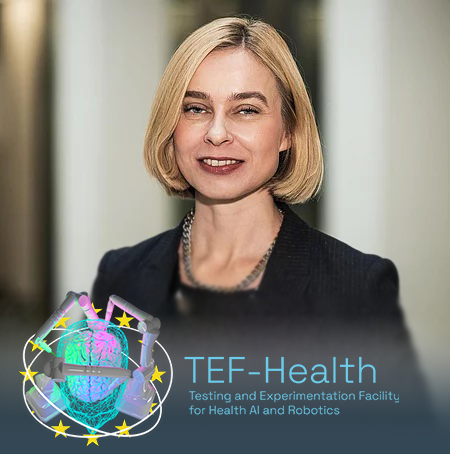
    We would like to announce and congratulate the launch of Testing and Experimentation Facility Health AI and Robotics TEF-Health, a project funded by the European Union and member states with 60 million Euros. Our own co-founder of The Virtual Brain, Prof. Dr. Petra Ritter, leads this new project, as well as the Brain Simulation Section at Charité in Berlin.

    TEF-Health has over 51 participants from nine European countries, including public and private institutions. The project aims to accelerate efficacy and innovation in the biomedical sector via the use of AI and robotics. Using automation for design, testing and validation, as well as merging cross disciplinary sources of existing research data, TEF-Health aims to bring new high demand biomedical technologies to market.

    For more information on the project, see here

    byJessica Palmer

    • petra-tef-health
  • Published:June 14, 2022

    • funding

    eBRAIN-Health project awarded funding by European Union!

    The Brain Simulation Section is proud to announce that the eBRAIN-Health project: Actionable Multilevel Health Data, coordinated by Prof. Petra Ritter, has been funded with € 13Mill by Horizon Europe.

    This comprehensive European infrastructure project is done in collaboration with EBRAINS AISBL and 18 additional European partners.

    The project aims to develop a new federated cloud platform for modeling and simulating of complex neurobiological processes.

    Find out more

    Do you want to discover more about eBRAIN-Health?

    Read the BIH press releasehere, and the News article from EBRAINS here.

    You can find further information on Horizon projects within Charité here.

    byChloê Langford

    • Petra EBRAINS
  • Published:February 14, 2019

    • virtualbraincloud
    • funding
    • press

    BIG ANNOUNCEMENT: Horizon 2020 supports VirtualBrainCloud project

    • Virtual-Brain-Cloud-group_gallery_big.png

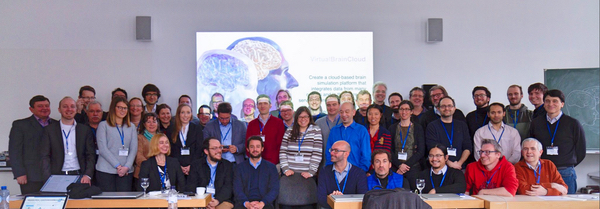
    The Virtual Brain was successful in a recent Research and Innovation Call of the European Commission Horizon2020 program with the topic "Exploiting the full potential of in-silico medicine research for personalized diagnostics and therapies in cloud-based environments".The newly formed VirtualBrainCloud consortium led by Prof. Ritter at Charité Berlin and Berlin Institute of Health comprises 17 European partners and is funded with mill€15. The main goal is to create a cloud-based brain simulation platform that integrates data from many centers and in the future can serve as clinical decision engine for patients with neurodegenerative disease. The consortium took up work in December 2018; the kick-off event for the VirtualBrainCloud took place on January 25th at Charité Univeristätsmedizin Berlin

    VirtualBrainCloud consortium:
    *PARTICIPANT ORGANIZATION NAME -- PI

    University Medicine -- Petra Ritter
    University Aix-Marseille -- Viktor Jirsa
    Fraunhofer SCAI -- Martin Hofmann-Apitius
    University of Oxford -- Simon Lovestone, Alejo Nevado-Holgad
    Forschungszentrum Jülich -- Simon Eickhoff, Thomas Lippert
    Brain and Spine Institute -- Jean-Christophe Corvol, Stanley Durrleman
    Inria -- Bertrand Thirion
    Institute for Bioengineering of Catalonia -- Paul Verschure
    University Helsinki -- Matias & Satu Palva
    University of Genoa -- Gabriele Arnulfo
    Complutense University of Madrid -- Fernando Maestu
    Codebox -- Jochen Mersmann
    Codemart -- Lia Domide
    Eodyne -- Pedro Omedas
    University Vienna -- Nikolaus Forgó
    Tp21 -- Petra Zalud
    Alzheimer Europe -- Jean Georges

    byTanya Brown

  • Published:June 10, 2015

    • funding

    New funding for large-scale brain simulations

    NIH and German Federal Ministry of Education and Research are co-funding a US-German project of

    • Indiana University Bloomington (PI: Sporns)
    • Charité Berlin and MPI Leipzig (PI: Ritter)
    • Jülich Research Center( PI: Morrison).

    The project is dedicated to large-scale brain simulations on supercomputers.

    byTVB Editor

  • Published:April 30, 2015

    • hpc
    • funding

    TVB got 11 million core CPU hours at supercomputer JUROPA

    TVB Applications Leader Dr. Petra Ritter got approval for the usage of 11 million core CPU hours on the supercomputer JUROPA, at Jülich Supercomputing Centre, Germany for her project "Identification of dynamical regimes in whole-brain simulations".

    byTVB Editor

  • Published:April 21, 2015

    • funding

    Baycrest Health Sciences receives $100 million funding for brain research

    Permanent Link

    We're happy to announce that TVB institution Baycrest Health Sciences has been awarded a $100 million funding boost from the Canadian federal budget!

    byTVB Editor

  • Published:October 22, 2010

    • funding

    TVB gets a second grant by the James S. McDonnell Foundation

    We're happy to announce that the James S. McDonnell Foundation has awarded a second multi-million Dollar grant to The Virtual Brain project!

    byTVB Editor

Subscribe to our RSS feed